
When separating, couples reach an agreement through mediation; one of the biggest questions is:
“Is our agreement legally binding?”
The simple answer is no, not immediately.
Mediation helps people reach practical, fair decisions without going to court, but the agreements made during mediation usually need an additional legal step if you want them to become legally enforceable. In most financial cases, this is done through a Consent Order.
At EH Mediation Bridlington, many clients are relieved to discover that they can avoid lengthy court battles while still achieving a legally recognised outcome. Understanding how a Consent Order works can give both parties certainty, reduce future disputes, and provide peace of mind that the agreements reached today will still protect them in years to come.
This guide explains everything you need to know about turning your mediation agreement into a legally binding Consent Order.
What Is a Consent Order, and Why Do You Need One After Mediation?
One of the most common misunderstandings is believing that mediation itself creates a legally binding agreement.
It doesn’t.
During mediation, both parties work together to reach mutually acceptable decisions regarding finances, property, pensions, savings, debts, or other matters following separation or divorce. The mediator records these discussions in documents such as a Memorandum of Understanding and, where appropriate, an Open Financial Statement. See Here: How Mediation Handles Pension Sharing in UK Divorce Settlements
While these documents accurately reflect the agreement reached, they are generally not legally enforceable.
A Consent Order is a court-approved legal document that converts your financial agreement into a binding court order. Once approved by a judge, both parties are expected to comply with its terms.
Without a Consent Order, either person may be able to make future financial claims, even years after the divorce has been finalised.
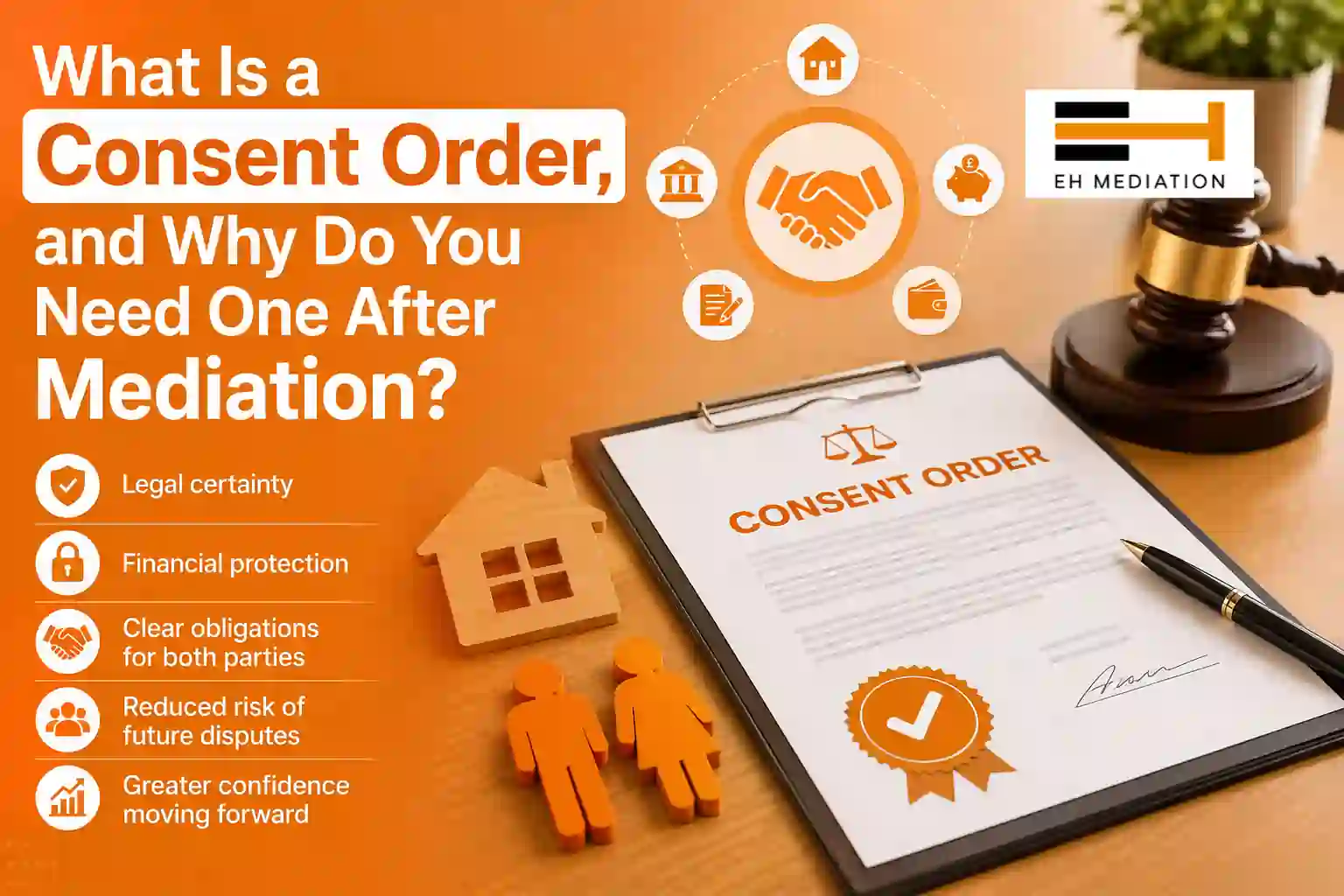
For many couples, obtaining a Consent Order provides:
- Legal certainty
- Financial protection
- Clear obligations for both parties
- Reduced risk of future disputes
- Greater confidence moving forward
How Does the Consent Order Process Work After Mediation?
Many people worry that obtaining a Consent Order involves another lengthy legal battle.
Fortunately, it usually doesn’t.
If mediation has already helped both parties reach an agreement, the legal process is often straightforward. Child-Focused Separation in the UK: What Every Parent Needs to Know?
The typical process looks like this:
Step 1: Reach an Agreement Through Mediation
Both parties discuss finances openly and work towards mutually acceptable solutions with the support of a qualified mediator from EH Mediation Bridlington.
Step 2: Mediation Documents Are Prepared
Your mediator prepares documents summarising the agreement reached during mediation.
These documents help your solicitor draft the Consent Order accurately.
Step 3: A Solicitor Drafts the Consent Order
Although mediators cannot draft legal court orders, a solicitor can convert the mediation agreement into the required legal format.
Step 4: Court Submission
Once signed, the Consent Order is sent to the court for approval.
In many cases, neither party needs to attend a court hearing.
Step 5: Judicial Approval
A judge examines the agreement to ensure it is fair and reasonable before granting approval.
Once approved, it becomes legally binding.
Can You Get a Consent Order Without Going to Court?
One of the most common questions separating couples ask is:
“Will I have to stand before a judge?”
In most cases, the answer is no.
If both parties have reached agreement through mediation and the paperwork is correctly prepared, the judge usually reviews the documents privately without requiring anyone to attend court. Mediation vs Court: Unpacking the Cost-Effectiveness for Families
This makes the process:
- Less stressful
- Faster than contested court proceedings
- More affordable
- More private
- Easier for families
Instead of arguing before a judge, you remain in control of the decisions while the court simply formalises the agreement.
This is one of the reasons mediation is often viewed as a more constructive alternative to litigation.
What Happens If You Don’t Make Your Mediation Agreement Legally Binding?
Many people assume that once they shake hands or sign mediation paperwork, everything is finished.
Unfortunately, this isn’t always the case.
Without a legally approved Consent Order, several risks may remain.
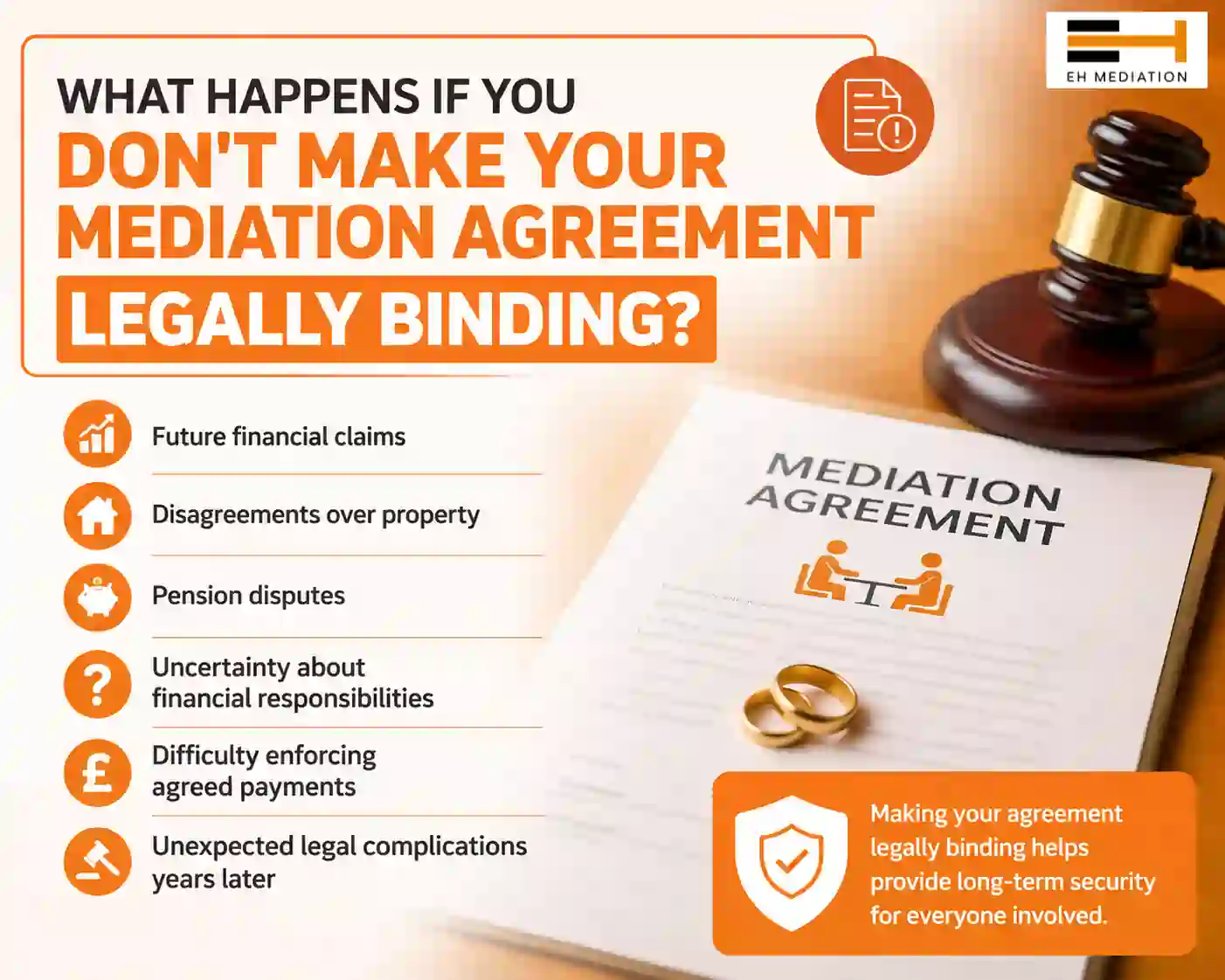
If your mediation agreement isn’t made legally binding through a Consent Order, you could face unnecessary uncertainty in the future, including:
- One party making additional financial claims later on
- Disagreements about the family home or other assets
- Questions surrounding pension division
- Confusion over financial obligations
- Challenges if agreed payments stop
- Costly legal issues months or even years down the line
For example, one party may experience a significant increase in income or receive an inheritance. Without a Consent Order, previous financial matters may not always be fully protected from future claims.
Making your agreement legally binding helps provide long-term security for everyone involved.
What Financial Matters Can a Consent Order Include?
A Consent Order can cover many of the financial issues discussed during mediation.
Depending on your circumstances, it may include agreements relating to:
- Family home arrangements
- Property sales
- Mortgage responsibilities
- Savings and investments
- Pension sharing
- Business interests
- Debts and liabilities
- Lump sum payments
- Ongoing maintenance
- Clean break arrangements
Every family has different priorities.
The advantage of mediation is that the agreement is tailored to your individual circumstances rather than imposed by a court after contested proceedings.
How Can EH Mediation Help You Reach an Agreement That Lasts?
Reaching agreement is only one part of moving forward after separation.
The aim is to help both people reach practical agreements that are clear, fair, and built to stand the test of time.
At EH Mediation Bridlington, the focus is on helping couples communicate more effectively, explore realistic options, and find balanced outcomes without unnecessary conflict.
Throughout the mediation process, clients receive support in discussing sensitive financial matters, identifying shared priorities, and resolving disagreements constructively.
Once an agreement has been reached, clients are guided through the next steps so they understand how their mediated outcome can be formalised through a Consent Order with the assistance of a solicitor.
By choosing mediation first, many families are able to:
- Reduce conflict
- Save on high legal costs.
- Maintain greater control over decisions.
- Protect important family relationships.
- Resolve financial issues more efficiently.
- Move forward with greater confidence.
When Should You Apply for a Consent Order?
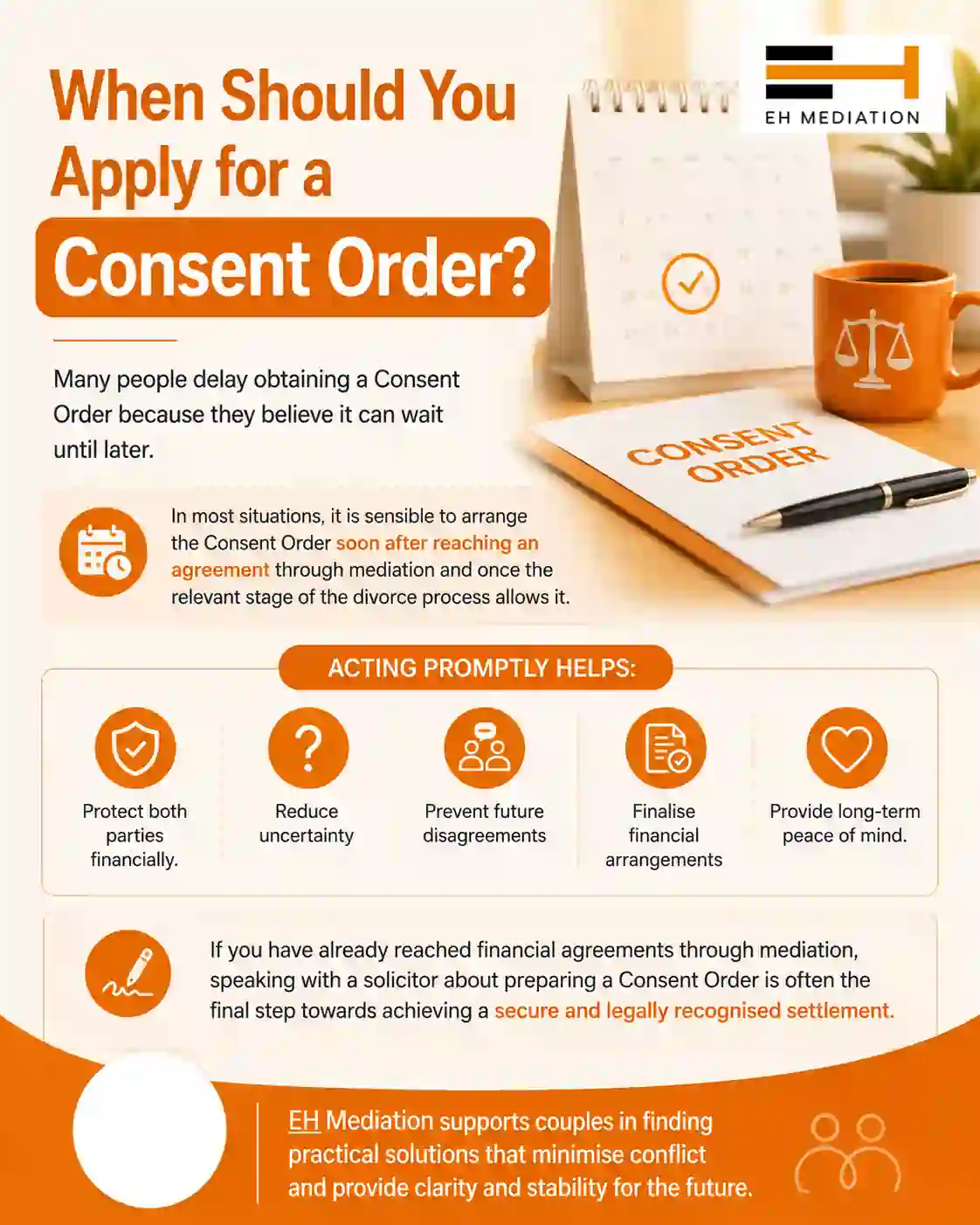
Many people delay obtaining a Consent Order because they believe it can wait until later.
In most situations, it is sensible to arrange the Consent Order soon after reaching an agreement through mediation and once the relevant stage of the divorce process allows it.
Acting promptly helps:
- Protect both parties financially.
- Reduce uncertainty
- Prevent future disagreements
- Finalise financial arrangements
- Provide long-term peace of mind.
If you have already reached financial agreements through mediation, speaking with a solicitor about preparing a Consent Order is often the final step towards achieving a secure and legally recognised settlement.
EH Mediation Bridlington supports couples in finding practical solutions that minimise conflict and provide clarity and stability for the future.
Frequently Asked Questions
Q: Is a mediation agreement legally binding on its own?
No. The documents produced during mediation usually record what has been agreed but are not legally binding. A Consent Order approved by the court is generally required to make a financial agreement legally enforceable.
Q: Do both parties have to agree before applying for a Consent Order Bridlington?
Yes. A Consent Order is based on an agreement reached between both parties. If no agreement can be reached, the matter may need to be resolved through court proceedings instead.
Q: Do I need a solicitor if I have already completed mediation?
While mediation helps you reach an agreement, a solicitor is normally needed to draft the Consent Order in the correct legal format before it is submitted to the court for approval.
Q: Can a judge refuse to approve a Consent Order Bridlington?
Yes. A judge may ask for further information or decline to approve an agreement if they believe it appears unfair or does not adequately deal with the financial circumstances of both parties.
Q: Does a Consent Order cover child arrangements?
Generally, Consent Orders are used for financial settlements. Child arrangements agreed during mediation are usually recorded separately, although they can sometimes be reflected in court orders where appropriate.
Q: Why choose EH Mediation Bridlington before involving the court?
At EH Mediation Bridlington, the focus is on helping couples resolve issues through constructive discussions rather than confrontation. Many families find that mediation saves time, reduces legal costs, and makes it easier to reach agreements that can later be formalised with a Consent Order.
For Further Information Please Contact Us